
Questions to Ask Your Parents (Before You Wish You Had)
Last week I was sitting with my Mum, and she mentioned, almost as an aside, that she’d once been chased by a goose on her way to school.
She was about seven. The goose belonged to a neighbour and had, apparently, taken against her specifically. Every morning for an entire term she’d have to cross the road to avoid it. Her Sister thought it was hilarious. She did not.
I’ve known my Mum for my entire life. How had I never heard this?
That’s the thing about parents. You think you know their stories. You’ve heard the big ones… the wedding day, the house they bought, the time they drove to Cornwall in the rain and the car broke down. But underneath those are hundreds of smaller stories that have never come up, because nobody thought to ask.
And those smaller stories? They’re often the best ones.
Why we don’t ask
I think most of us assume we’ll get round to it. There’ll be time. We’ll ask over Christmas, or on the next long car journey, or when things are a bit less busy.
But busy is a permanent state, isn’t it? Christmas comes and goes. The car journey is spent arguing over the satnav. And the years slip past in the way they do, quietly and all at once.
There’s also something slightly awkward about sitting your Mum or Dad down and saying, “Right, tell me everything.” It feels formal. It feels like an interview. It can feel, if we’re honest, a little bit like you’re doing it because you think they won’t be around much longer. Nobody wants to send that message.
So we don’t ask. And then one day we wish we had.
The good news is that it doesn’t have to feel like an interview. The best conversations happen naturally, over a cup of tea, whilst doing the washing up, on a walk. You just need the right question to get things started.
Start small
The questions that unlock the best stories are rarely the big, heavy ones. They’re the specific, everyday ones. The kind that make your parent smile and say, “Oh, I haven’t thought about that in years…”
Here are a few of my favourites to start with:
What was your childhood bedroom like?
This one opens up so much. You’ll hear about shared rooms, wallpaper they hated, the view from the window, hiding under the covers with a torch. It grounds them in a time and place, and suddenly they’re seven years old again, telling you things they haven’t thought about in decades.
What were your favourite sweets as a child?
Don’t underestimate the power of a question about sweets. You’ll get the name of a shop. A memory of pocket money. A story about sharing (or, more likely, not sharing) with a sibling. It sounds trivial, but these are the details that make a life feel real.
What was the first meal you cooked by yourself? Was it a success?
The answer is almost always no, it was not a success. And the story of why is usually brilliant.
Do you have any stories about learning to drive?
My Mum’s driving test story is one of my favourites in her whole book. I won’t give it away here, but I will say it involves a roundabout, a moment of panic, and a very patient examiner. Everyone has a driving story. Ask for it.
What was your favourite TV programme growing up and why?
This one sounds light, but it’s actually a window into a whole era. You’ll hear about what life was like before remote controls, about the one television in the house, about the programmes the whole family gathered round for. It’s social history through the eyes of someone who lived it.
When you’re ready to go a bit deeper
Once you’ve got a conversation going, you can gently move into questions that dig a little further. These aren’t difficult or heavy, they’re just more reflective. The kind of questions that make your parent pause, think, and then tell you something you’ve never heard.
What did you want to be when you grew up?
And how did that compare to what actually happened? There’s usually a wonderful gap between the dream and the reality, and a story in that gap that tells you a lot about who they are.
Who had the most positive impact on you as a child?
This might be a parent, a grandparent, a teacher, a neighbour. You’ll hear about someone who shaped them in ways they’re still aware of, and quite often you’ll learn something about your own family you didn’t know.
What was one of the hardest things about growing up? How did you get through it?
You might be surprised by the answer. What felt hard to them might not be what you’d expect. And how they got through it tells you something about the resilience they carry, the kind that gets passed down without anyone noticing.
What did you learn from your parents that’s left a lasting impression on you?
This is a generational one. Your parent is telling you what their parents taught them, which means you’re actually hearing three generations of wisdom in a single answer.
How did you know you were really in love?
Yes, you’re asking your Mum or Dad about love. It might feel a bit strange at first. But the answer is almost always worth it.
The questions that really matter
These are the ones people most often wish they’d asked. They’re not morbid or sad. They’re the questions that get to the heart of who your parent really is, as a person — not just as your Mum or Dad.
What are you most proud of in your life?
It might be their career. It might be you. It might be something you’ve never heard of. Either way, you want to know.
What mistakes have you made in your life? What would you do differently?
This takes courage to ask and courage to answer. But parents who do answer it honestly tend to open up in ways they haven’t before. There’s something freeing about being asked.
What advice would you give your 20-year-old self?
This is one of the questions we include in our YourStory books, and the answers are always fascinating. They’re usually short, specific, and surprisingly emotional. If you only ask one question from this entire list, make it this one.
How do you want to be remembered?
It sounds big. It is big. But most parents, if you ask them gently and with genuine curiosity, will give you an answer that tells you everything about what matters to them.
What are you most grateful for in your life?
A lovely one to end on. And one that reminds both of you what’s really important.
A few tips for asking
Don’t make it an event. The best conversations happen when they don’t feel planned. Slip a question into an ordinary moment — over dinner, in the car, whilst making a brew. If it feels natural, they’ll relax into it.
Let them wander. If your Mum starts answering one question and drifts into a completely different story… let her. That’s where the gold is. The tangents are the best part.
Write it down. Or better yet, keep it somewhere safe. I say this because I know from experience what happens when you don’t. You hear a wonderful story over Sunday lunch, you think I’ll remember that…. and six months later the details have gone fuzzy. Memory is a leaky bucket. Find a way to catch what comes out.
Don’t try to do it all at once. One question per visit is plenty. Your parent won’t want to sit through a questionnaire… and honestly, the stories are better when they come out one at a time, at their own pace.
Start before you think you need to. This is the one I really mean. Nobody ever regretted starting too early. But an awful lot of people regret starting too late.
One more thing
When my Brother David and I lost our Dad, we lost his stories too. He’d lived abroad for much of his life, and most of the relatives on his side are gone. So when he died, everything he hadn’t told us went with him.
That’s why we built YourStory.
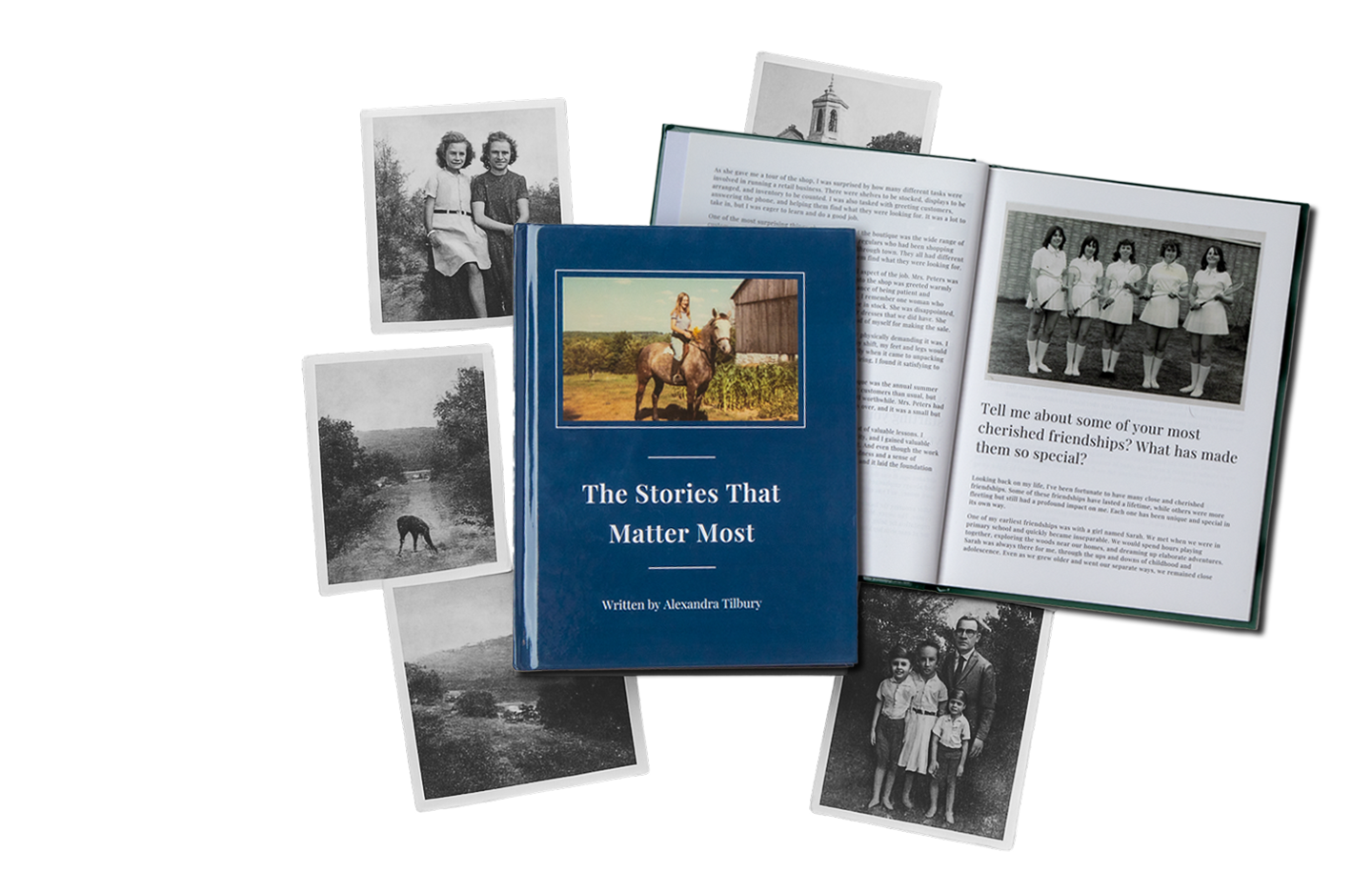
It’s a book of 232 guided questions, the kinds of questions in this post, and many more, that your Mum or Dad can answer at their own pace. When they’re finished, we turn their answers into a hardback book. A proper big one, nearly A4… the kind you leave on the coffee table, not in a drawer.
I get to see some of these books. And I can tell you honestly, they are extraordinary. Ordinary people, telling their own stories in their own words, and producing something their family will keep forever.
If you’ve been thinking about doing something like this for your parent, you can take a look at how it works at yourstory.co.uk.
And if you’re not quite ready for that… just start with one question. Over a cup of tea. This weekend.
You’ll be glad you did.
Alyson